Tuesday, October 1, 2013

Sunday, September 1, 2013
Friday, March 1, 2013
Tragedy is When I Cut My Finger
As a comedian, I often push a lot of buttons. One, because my kind of rough life experiences and mild deamnor give me a lot of currency to take my humor to the gallows. And secondly, because I like to think that I put a lot of effort into making sure my targets are clear.
It seems The Oscars has attracted a bit of controversy on all fronts: Which may or may not be what they wanted. There were some misgivings about Seth McFarlane coming along and doing what Seth McFaralene was hired to do. As a local from Rhode Island, it's funny to think his stuff actually may have been a bit too cerebral for his "never got off the ground " comedy career. But it may have created a little bit of "pushing the envelope" osmosis.
The Onion caused a stir when, on its twitter account, it made a comment saying " Everyone else seems afraid to say it, but that Quvenzhané Wallis is kind of a cunt, right? #Oscars201". This caused an outrage, first of all, for using the last great four letter word that must not be said. Secondly, because of the racial connotations (the idea that a person of color is fair game, or that they seem more "required" to act demure as possible, with little wiggle room). The Onion says their intent wasn't in targeting Wallis, but in the snipes that people tend to make in light of these Oscar ceremonies. That somehow, the armchair analysts of popular culture have just gotten too mean-spirited.
I kind of have been going back and forth on this. I'm not the largest fan of the gossip industry. Now, I'm hardly going to pretend that the Academy Awards are an untouchable bastion of prestige...the very high school prom nature of it, in addition to the decadence of the jewelry, the food, the party has all pretty much rendered the purity of it all a lost cause. Nontheless, there's a part of me that always winces when the ceremony attracts people who aren't into it because of the movies. And even those who are, will say, glom onto say, the irritating aspects of Anne Hathaway. Hathaway has kind of become the poster child (or at least soup du jour) for how much media gadlfys like to really let Type-A seeming actresses have it. (Or Type-C, with Kirsten Stewart's fog apathy inviting equal criticism). I'm not the first, and I won't be the last, to point out that the one upmanship of snark that's started since "Best Week Ever" (is that show still on) has very few places to go. Making that comment about Wallis is the logical conclusion. "But she's just a girl", they say. "She shouldn't be in the midst of that", but the thing is, with America being on a first name with Brad Pitt and Aneglina Jolie's offspring, culturally speaking, they're already out in the open. The media, the paparazzi, the blogs, they've helped break down barriers turning children into fair game. It was only a matter of time before someone said that about a nine year old actress, and meant it.
But there comes the rub. Sometimes excellent satire (which the Onion comment really wasn't, but anyways) is hard to distinguish from that which it's satirizing. People will take Fight Club at face value. People will take Dave Chapelle's act at face value. The Onions point was maybe to make people feel a little uncomfortable and shocked. But what if not everyone considers that a wake-up splash of water, but a refreshing dip. I've seen a lot of comments along the line of "To be fair, she did seem like a little bit of a cunt". Sometimes the worst thing that can happen to a comedian is to be enjoyed by the very people being made fun of. So I think in the light, we should declare the experiment a failure, where the humor was more appreciated by folks the writers did not want to be appreciated by. Hence, the apology, which some champions of humor felt they should never have had to do.
Ultimately though, let's hope the day doesn't come when the Onion's affected faux-outrageousness doesn't become milder than the real thing. Especially since one wonders where one would take that?
Friday, February 1, 2013
The Dance Between Art and Commerce
A couple of years ago, I did a post here talking about the wide swath of populist-skewing Oscar pictures; winner The King's Speech, Black Swan, The Social Network, The Fighter, as well as "second tier" movies like True Grit and Inception. (Although to some degree, Inception wasn't so much an "Oscar movie" that was popular as a summer blockbuster with prestige.) It looked like perhaps a new trend in so-called adult movies gaining traction in the ticket sales. However, the next year seemed almost a complete reversal in that direction. In contrast, the only movie to cross the 100 million mark amongst the 2012 nominees was The Help. Scorcese's Hugo was much admired but couldn't quite appeal to the masses, Speilberg's War Horse was considered obligatory, Terrece Malick's Tree of Life made no pretense of appealing to the masses, and the Best Picture was French, silent movie The Artist. It was almost as if unto a rebuke on the Hollywood for its especially egregious year of sequels, remakes, reboots, whatever you want to call them.
2012 seems to have, for now, found a balance between the populist and the pretigous. The highest grossing film of the year, The Avengers, was of course, yet another comic book movie, and a sequel to four of them at that. But it was generally considered, at the very least, an exercise in how to execute the blockbuster in a comprehensible, crowd-pleasing manner. Skyfall was looked at as one the best James Bond movies ever made (and saw a recognition in many of the techs). And there seemed to be a strong trend of decent-sized hits in Argo, Lincoln, Les Miserables, Silver Linings Playbook, even the very hard sell in Life of Pie and Zero Dark Thirty.
Is there a trend here? Hard to say. It's possible that the success of non-franchise pictures gave the studios more confidence to do more of the same. (After all the Hollywood cycle takes a couple years to really take effect.) Maybe the large hits seen in the spring of 2012 gave much of fall movies a lot of publicity. Perhaps what happened was, after Aurora Colorado incident, which caused moviegoing to be lacklustre for a couple of months, there was room for Argo to break out. Argo in turn, advertised many future Oscar hopefuls, and its signaling that the race was on served as an incentive to see its competition. Maybe one solid film just drums up excitement about moviegoing, I remember 2005 got a lot ink as "the summer of the slump", and in turn, may Oscar hopefuls had a weak box-office. Maybe the relationship between summer movies and Oscar bait works at a kind of symbiosis. Lack of enthusiasm about on will hurt the other. Studios should make sure its meat and potatoes are in equal portions, and both the best at what they could be. But who knows?
Tuesday, November 6, 2012
Saturday Night Live and Elections: A Look Back
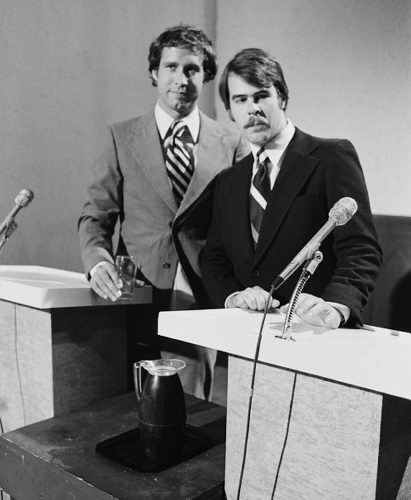
"Saturday Night Live" has always thrived on current events, and its topical humor always reaches critical mass during the Presidential Elections. Sometimes the show hits the mark so completely that it causes America to look at the entire race with their eyes, and sometimes they drop the ball, making their contribution to the conversation almost obligatory. This can be the the result of several factors; The talent of the show, how colorful the candidates are, or even the mood of the country. So I'm going to reflect on the highs and lows, the starmarkers and the forgotten ones.
Election 1976: It's kind of funny to think how bare bones this approach was. Chevy Chase did not look anything like Gerald Ford. And Dan Aykroyd saw no point in shaving his mustache in order to greatly resemble Jimmy Carter. Making oneself up, working on impressions, would be the kind of thing that would go on to embody later incarnations of the show, but was almost anathema to the "break all the rules of television" mentality the show was possessed. It was very much a post-Watergate show. It capitalized on the younger generation's distrust of the nation, and of politics. While a lot of the humor is, in its own way, more silly than biting ("This just in, Francisco Franco is still dead"), and Chase's signature Ford impression just falling a lot, it was at the time, some of the most intelligent and cynical political stuff on TV. It also showed how SNL could often frame the popular consciousness's view of politicians--and the ability to get politicians to appear on the show to stay on their good side!
Election 1980: Now, this was hurt by two factors. One is that the very year was split between two completely eras of the show. Changeover in cast, writers, practically everybody. Secondly, neither of these two sets of shows were very good. Early 1980 was characterized by exhaustion. The show had a great deal of the Republican Primary challengers played by every writer in the cast (It's funny to look at James Downey's quiet, nonexistent impression of George Bush), but what's funny is that Regan, despite being a well-known personality even (especially!) in the world of media, really doesn't come through, even though he's probably one of the more iconic and impersonated presidents, even without contributions from SNL (of which there were relatively little). For the fall season, we also saw some strange "Dalls" style parody of Reagan, which is more known for allowing the word "fuck" to slip on the air, and shattering an already fragile existence. I think if I were to rank all them, I would put this at the bottom. It seemed a very strange bungling of probably one of the most important elections ever.
Election 1984: I kind of don't even see the point in counting this. Except for Jesse Jackson's hosting spot, the era of Dick Ebersol was notoriously apolitical, to the point Harry Shearer left over feeling constrained by a safe, voiceless mode of doing comedy. (Then again, it generally doesn't take a lot to perturb Harry Shearer from a creative standpoint.) I suppose the climate didn't really provide a lot of room for satire--Reagan was an extraordinarily popular president and the 80's a very safe zone for the Right. Without a particularly transgressive collection of talent, (And the latter half of the decade would get much more acerbic) SNL largely fell back on recurring characters.
1988: By this time, SNL had reverted back to Lorne Michael's command, and was written by old standby political junkies like Al Franken and James Downey, as well as newer writers would greatly shape the show, like A. Whitney Brown, Conan O'Brien, and Robert Smigel. The show was ready to take more shots at Reagan, (And Olliver North), and a lot of humor with a global bent. The cycle is well known for its two "primaries" sketches, (One which included Kevin Nealon as Al Gore. This would not be the last the world heard of Al Gore. And Nealon would be on SNL for a while longer, for that matter.) Carvey's Bush was always evolving, from someone a little more cocky to someone a little more frayed, but always hungry for public approval. Carvey's regular appearances as Bush would become part of show legend, but he was a very different figure in the campaign sketches. While the debate with John Lovitz's Michael Dukakis was very, very funny, and this was probably the smartest the show had ever been written, I think pitting two dull, almost cypher-like presidents at the time must have provided an immense challenge, and I think it's a testament the political humor at the time holds up so well.

1992: Like I said, Carvey's Bush was always evolving. From a larger perspective, it's actually very fascinating to see Carvey go from someone winning as essentially a third Regan term, high off goodwill for the GOP, dominating the Gulf War, to somebody losing his hold on public approval to the shady, almost Renard-like figure of Bill Clinton, played by Phil Hartman, who gave Clinton a sort of "I don't know what the big deal is" aura. 1992 was a very interesting time for the show. Probably the most popular, coming off the success of Wayne's World. It was a merging, sometimes unwieldly, of the sophisticated SNL of the late eighties, infused with fresher, younger, and sometimes more dangerous talent. Bush vs. Clinton built up on a dynamic that would perhaps define SNL's campaign sketches from here on in; We would see a sort of "Caddyshack" dynamic at play-slobs vs. snobs. An Oscar vs. a Felix. By now, Carvey's Bush would be completely cemented as a wet blanket. But that wasn't all. The 1992 election also had the colorful element of Ross Perot. (Also played by Carvey)
1996: It's kind of strange. Darrel Hammond's Bill Clinton was considered a perfect impression, and his adventures as a womanizing, lying, hedonistic trickster figure made for some great highlights in the late nineties. But his Bill Clinton was not utilized a great deal until the Lewinsky scandal, and not a lot during the election. Norm MacDonald was always Saturday Night Live's odd duck. Sloppy, ironic, and verging on ati-comedy, he might have been a better fit in the 70's. He always seemed to enjoy the camaraderie of the early 90's "bad boy" era he came at the tail end of. But by chance, he presided over Weekend Update during a major turnover, when the show went from primarily a gathering place for stand-up comics, to the more tightly knit "drama club" style. And by even stranger chance, MacDonald was cast as Bob Dole, heavily made up, cantankerous and socially maladjusted. Dole would eventually go on to be the Republican nominee, and the outsider MacDonald the centerpiece in 1996's political coverage. MacDonald himself didn't much care for being in sketches, and it's possible the heavy makeup and participating in bits he didn't orchestrate himself probably burned himself out on the show. Still, he carried it quite well. His debating with Bill Pullman's president from "Independence Day", being kicked off "The Real World", or confronting Steve Forbes about his thinly veiled novel, MacDonald's Dole was another in a long line of failed candidates who couldn't relate to people, but one who was a lot more stubborn and venomous about it.
Election 2000: In a lot of ways, this was the stars aligning. "The Presidential Couple" quite literally capitalized on the Oscar/Felix dynamic. Bush was the simplistic party boy, Gore the ubernerd quite proud of how proud he was. Darrel Hammond and Will Ferrel were strangely perfect, even though Hammond is noteably shorter, and Ferrel didn't sound much like Bush (and kind of left out a lot of Bush's 'born again" persona). It didn't matter. They were acute parodies of what politics had come to. It was even to the point Bush and Gore looked at the debates, to correct what they had done wrong. They appeared on the show to appeal to voters, to show they got it, that voters weren't quite sold yet. But what really took it to the stratosphere was the recount debacle. It was the sort of situation one couldn't make up, creating a weird soap opera, which of course, was one of the sketches. SNL's handling of this election season is what put it right back on the map, culturally. People like Tina Fey and Will Ferrell had their profiles considerably upped, and it never went out of style since, although there was always the requisite complaints of decline in quality.
Election 2004: Over the ensuing four years, a somewhat united stance on the ridiculousness of the candidates and common sentiment over 9/11 gave way to a very, very bitter divide between left and right. This was not the election of 2000, where the quite, prosperous 90's left room for irreverence. People were angry. Angry about war. Angry about gay marriage. Perhaps this would have been the perfect opening for fantastic satire and reflection, but by this time, SNL seemed to play things generally safe. This generally didn't mesh well with a political climate that was either full of fury or malaise. It didn't help that challenger John Kerry was not a particularly dynamic figure. Now, that doesn't always hurt--as we've seen before, having an absolute square can be great if they're a foil to a more boisterous figure. However, while Will Forte is one of the funniest cast members, (His Zell Miller was a highlight during this period) he made the choice to play Bush as someone who was quite aware of his waning popularity, but maybe couldn't understand why. Now, the cocky-to-flailing Bush arc actually worked as Dana Carvey did it, but with a generally more unpromising, and less colorful race, this tended to suck the humor right out of the room. For his part, Seth Meyer tended to use his time in the spotlight as a polemic, and it got to a level of discomfort when he opened the show, as Osama Bin Laden, trying to play it up as the "voice of reason", then made a wife-beating joke re: Theresa Heinz. All in all, the kind of stuff a master of dark humor could play up, but generally awkward with SNL's happier, "theater geek" style that has dominated since the late 90's.

2008: One of the most historic races ever, but all due considering, not something the show always capitalized on. I think we can largely lay this on the casting. At the end of the day, the two candidates were John McCain, played by Darrell Hammond, and Barack Obama, played by Fred Armisan. Hammond, by this point, had been on the show for over a decade, and by now it tended to show. His McCain was accurate, but he was not having as much fun with it as much as he did as slick Willy, or the fascinated-wth-his-own-nerdiness Gore. McCain by this point had appeared on SNL himself, and always seemed more game to do it. For that matter, Obama himself appeared in a cold open, the first president to appear on the show before elected. Obama himself, it has been remarked, has been extraordinarily difficult to satire. This is probably because, when you're the first black president, you try to avoid displaying palpable quirks. At the same time, he wasn't aloof it robotic, dorky way that Gore, Dukakis, etc have displayed. Obama bits were further restrained that Armisan was always treading dangerously close to blackface. There was some mileage early on, with Amy Poehler as a constantly frustrated Hilary Clinton, but by Obama's nomination, there was little to go from there. However, there was one Godsend, and that was Sarah Palin. She was every bit, the self-assured, down-homey lover of the camera Bush was. And what's this? She looks remarkably like Tina Fey? At this point, the campaign sketches were writing themselves. (And in some cases, they were!) However, I think it says a lot about this period that the most iconic performer in this cycle wasn't even technically a current cast member. It always had this air of being somewhat removed from the rest of the show, and once the election was over, the White House was always a bit peripheral.
2012: People always say "their' era of SNL was the best, as generations older dismiss the show as having gone to pot. But I do think there was always been a fondness for the "core four" of Andy Samberg, Bill Hader, Jason Sudekis and Kirsten Wiig. Appearing almost at the same time, one could sense a bond between the four of them, especially visible in the fellowship breaking in the 2012 season finale sketch dedicated to Wiig. So it would seem sad they never really got to make their mark this season, since it was believed 2012 would suffer the same malaise 2004 did at the polls. But then something kind of amazing happened. The Republican primaries became, well, let's just say it was incredibly illustrious. Romney, the eventual nominee, would play straight man, but not to Obama, but to his fellow GOPers, all vying for the spot. Bachman, Gingrinch, Cain, all had their time in the spotlight, all becoming favorite for a weak, as voters looked for someone, anybody, more exciting than Mitt Romney. It was even put into such terms as Jason Sudekis's Romney describing himself as the best friend at the end of a romantic comedy. Perhaps the biggest downside to this "flavor of the month" race was that we would often see a cast member playing a candidate just because they were a warm body, but then find they were the star of a sketch, and then disappear into the background once the passion was over, before they really had time to develop. This was probably most evident in Samberg's Rick Santorum. There were many other angles to play, too. Bobby Moynahan's Chris Christie, as the broski who gave Romney lip service but was never really behind him, or Kate McKinnon as Ann Romney, lamenting her lack of cool kid status, but standing up for her man nontheless. A large and able ensemble worked around the two main players who in real life, were trying their damndest not to make mistakes. Jay Pharoah's superior Obama didn't hurt, either.
Sunday, January 1, 2012
Heroes in a Sorting Hat-Shell

Literature and pop culture likes number four. Well, I guess we're into dualities and trinities as well, but when we sort things into four, we can really explore how society works, at least on a microcosmic level. The four elements, the four humors. It's a fun pastime to determine which niche we fit in. J.K. Rowling's Harry Potter books often makes for one of the more popular personality surveys, the house sorting. Gryffindor, the house of daring-do, Ravenclaw, the house of exteme cleverness, Hufflepuff, the house of fair play, and Slytherin, the house of...something vaguely sinister, but don't judge a book by its cover, okay? Cracked! also recently did a piece on how one fits one's social circle into four easily divisible pieces. So it seemed natural (If incredibly dorky) to ponder how the Teenage Mutant Ninja Turtles would be sorted into Witchcraft and Wizardry. (Ignoring that they possess no magical powers and as nominal citizens of New York, they are outside Hogwarts jurisidiction) Of course, they turtles' outward qualities seem to make them easy to sort, but it occurred to me it's not that simple. It should also be said that the Sorting Hat is about choice, and that very rarely is a student destined for one kind of house. It's about how we define themselves. And hey, who knows more about defining oneself than an orphaned mutant reptile with the name of an Italian painter well-versed in ninjistsu?

People probably associate Raphael with Slytherin. He seems to be the most ornery, and Slytherin is not a House renown for its avuncular nature. I think this also may have a little something to do with fanfiction's (particularly writers like Cassandra Claire's) own interpretation of Slytherin in general, and Draco Malfoy in particular. That is to say, wizards as imagine by Joss Whedon. Irreverent, iconoclastic, snarkers who secretly hope for redemption. But there's really very little in that whole mess that resembles Slytherin House. Whether or not J.K. Rowling has been fair in her representation of them, people forget they aren't anti-establishment, they are establishment. They don't have a problem with authority, they have a problem with Dumbledore. They tend to resent when they're not in charge, not possess a skepticism of the chain of command in general. They can be quite partisan about things. Also, they don't seem to have much of a sense of humor outside the "so's your butt" school of wit. Which granted, Raphael can stoop to that level when he gets angry enough. But he's a loner, an outsider, and very intent on looking clever, to say nothing of preoccupation with looking cool. Ralph is just the most likely to look at his family and think "This can't be it, can it?" Raphael is kind of the rarer facet of Ravenclaws...he's a little bit more belligerent than they tend to be, but I think in general, he has the skepticism and taste for the exotic (Anyone get the sense he's the turtle most likely to make the move on April?) that I can imagine him in this house. They may even give him more outlets to express himself than his very small pool of associates can provide.

A first instinct would be to place Donatello in Ravenclaw House. It's seen as the "big brains" club of Hogwarts, and Don is certainly the requisite polymath all cartoons requite in order to whip up the "machina" in the deus ex machina (to say nothing of inventing impressive new swag to fill the toy shelves with). And I'm not saying Donatello wouldn't find a niche here, but there's one major thing to keep in mind; Donatello is just not eccentric enough. I mean, yes, whenever Don explains neutrinos or something the other turtles shrug, but he's hardly the black sheep. In fact, they kind of defer to him. I'm not saying Ravenclaws aren't tinkerers, but they're geniuses of the Nicholas Tesla variety. If they were to engage in science, it'd be of the mad kind. They'd ostracize their fellows, either with an Aquarian love of doing so, or an Aspergian obliviousness they're doing it. Of all the turtles, he actually seems to be the least prone to doing his own thing, except when requiring the solace to concentrate. Don's actually brilliant, but his inventions are a means to an end. He's less likely to whip up an invention to show off as to be given a task and using his resources to surmount it. Of all the turtles, Donatello seems to he most invested in the foursome as a cohesive unit--he's just there to do what he can. Thus, he's perfect for Hufflepuff.

Fan fiction has sort of mythologized Slytherin as the house of outsiders. The malcontents. The iconoclasts. This is largely because their pursuit of the "Dark Arts" has made them seem more "wizardy" than the rest, as well as fixation on the dynamic between Severus Snape and Harry's father, James. Gryffindors are the "jocks" of Hogwarts, so their natural enemies would be the anti-jock. This of course ignores little Draco Malfoy being as Quidditch crazy as anyone. No, it's just that bringing our muggle filter through the upside-down wizarding world we sometimes forget that the Slytherins are the traditionalists. A lot of times, this kind of manifests itself through allegories for white supremacy, but it's very clear that a SLytherin is very likely to be very...clannish. When house founder Salazar Slytherin made his concerns about not allowing muggle-borns, it was a fear of muggle society. And Leonardo, while far from contemptuous of the human race, seems to fall in line with Splinter's isolationism. It should also be said Leo has been a bit of a Luddite, or at least a fetishist for old-timey warrior practices. He seems to have the most reverance for ninjistsu, bushido, and I even the occasional enlightenment-era swashbuckling. The point is, Leo seems like somebody who would be reasonably happy in a previous century (or a t least a romantic interpretation of it), the modern mutagenics that made his cognizance possible notwithstanding.

Michelangelo is probably thrown into the Hufflepuff house, because it just has it in fandom that it's the house with no discerning qualities. This is of course, a mischaracterization of the badger-standard. The thing is, Mikey would never get along there. For one thing, is work ethic is atrocious. Secondly, he has a force of personality that would chafe under the collective nature of Hufflepuffs. Mike's a born Gryffindor. Is there anyone else who displays the dueling traits of an insatiable joi de'vivre combined with a crippling neurosis like perennial Gyrffindor House attendees, the Weasleys. I think of all the turtles, Michelangelo has the strongest feelings about heroism--it's just Leonardo is more committed to duty. Michaelangelo always seems the first to hero-worship (he's the Ninja Turtle with the most extensive, if not only, comic book library), and hungers the most for adventure for its own sake. He's also, mind you, an inherently lucky person despite his lack of discipline. As I've alluded to before, there seems to be a resentment towards Gryffindor House amongst some fans, probably in no small part Gryffindor claiming the house cup the duration of Harry's academic tenure. But that's just thing, Gryffindor only started collecting the cup after a long, long absence from it. And it really wasn't getting those kudos through an Academic decathlon, or even Quiddich successes (The team tended not to win the cup half the time) but through Harry and friends' daring, conspicuous stunts. Not unlike Mikey's breezing through the Multiverse fighting championship despite all logic.
As for Master Splinter? Well, with his love of serenity and penchance for Renaissance Art, he's clearly a Beubaxtons Beauty.

Tuesday, November 1, 2011
Why Is it Just This Once Upon a Time?

"Fairy tales", are considered, perhaps, a somewhat small segment of overall mythology and folklore. If I were to define what a fairy tale is in exact terms, I would probably mention two things: 1) That the main character is rewarded with material prosperity, and perhaps marriage and 2) The aspect of "helpers". Many characters in fairy tales are kind of meek, and it's usually through a "one good turn deserves another" series of events, whether via denizens of the animal kingdom or a mysterious elderly stranger, that rewards the protagonist through kindness or hard work. The way these stories worked was enough for oral folklore, or for children, especially in a short stint. But as our folklore has moved to longer, and sometimes more visual mediums, we tend to like our legends to be a little more...martial in their presentation. Hence a story where nobody throws a punch is overtaken by the mantra "People had swords back then...why not use them?" Once Upon a Time's Prince Charming is something of a badass, who we see spill blood. (and have blood spilled!) Whether our fiction has become more proactive or belligerent is a story for another time, but my point is, it's starting to blur with a lot of "Heroic Age" mythology, or modern high fantasy.
In the various flashbacks, we see background characters...a clergyman here, a guard there, who is clearly a person of color. A few mythology and fantasy enthusiasts get quite perturbed whenever they see non-white faces in adaptations of Germanic legends. This of course, tends not to reflect on the complainers. I don't have a problem with color blind casting per se. It's hardly going to disenfranchise white people the world over if a large scale production features a non-white captain of the guard or something. But seeing it raises a few problem too. First off all, way to not have the conviction to put a person of color in a main role. But also, I'm led to ask "What's a few roles here and there if most of the fairy tale characters are just from Germany, France, and maybe one or two from Italy" Europe is a very small "continent" in a very large world, and there are countless amazing stories from Africa, the Middle East, India, China, and the Americas.
There's a Chris Rock joke about how Shaquille O'Neal is "rich", but the the man who signs his checks is "wealthy". I think of that joke whenever I see people talk about giving a non-white actor a chance in a European fantasy story. To simply give people of color roles (And token roles at that) does not address the institutional problems at hand, namely the very Eurocentric world view. And you can make your fantasy kingdom as anachronistically inclusive as you'd like, that doesn't make it truly egalitarian. It just means non-whites have a seat at the table that whites have built. Right now, the standard fantasy setting is based on Lord of the Rings. This is because its author, J.R.R. Tolkien, was an enthusiast, some might even say fetishist, for anglo-saxon folklore. In order to allow minorities to flourish in a genre that sometimes warrants aspersions on the race issue, we need to go back to the route. We need break out of a frankly chauvinistic worldview, which is that Europe is the pinnacle of storytelling and mystic-infused heroism, and that the United States is the natural successor. It's a perhaps unintentional, but hopelessly western view of things. And it is probably a temporary solution to a largely institutional issue. If we keep spinning the same Snow White yarn, but just occasionally throw in minorities, instead of truly drawing from their often rich heritage, it just seems, as they say, mighty white of us.
Fantasy, the European kind, has become a bit of a trend this decade. But people will embrace Anglophilic cinema, and yet not wonder why things are going wrong, from a race standpoint. In fact, the only recent franchise to draw inspiration from outside European tropes was Avatar: The Last Airbender. Which was kind of the brainchild of two white creators, but was purported to be a well-researched take on Asian culture. But of course, then they made the movie, and cast white actors in all the lead roles, with minorities so graciously being handed the secondary ones. This of course, ended up creating a goose-and-gander scenario of color-blind casting, as opposed to a chance to give the world a real alternative the typical fantasy nodule.
Mind you, I'm not urging for some kind of segregation. No "white people should want to be this, but black people should want to be this." If, after hearing a collection of stories from around the world, a young African-American girl still decides she wants to be Cinderella rather than Marimba, I'm all for it. My point is, authors are more important than the dressing. For social mobility, the marginalized have to be allowed to be the architects of culture, not hope to benefit from a trickling "generosity", which can ebb and flow. In order to make American fiction truly multicultural, we should go for multiculture, not the one culture with the occasional new candy shell.
Besides, how many different ways can one reinvent Snow White anyway?
Subscribe to:
Posts (Atom)